Welcome to the Token Economy


Every generation or so, a new resource becomes the organizing principle of the global economy. Oil reshaped the 20th century: the countries that controlled it wrote the rules of geopolitics, the companies that refined it became the most powerful on earth. Electricity did the same, more quietly, embedding itself so deeply into modern life that its absence is now unthinkable. We are at the beginning of a third inflection. The resource is the token. The infrastructure is the AI factory. And the race to produce, distribute, and efficiently consume tokens at scale will define the next decade of economic competition as surely as pipelines and power grids defined the last two.
This isn't a metaphor. It is already showing up in the hard data of global trade.
Tokens Are Already Reshaping the World Economy
The AI boom isn't just visible in stock prices and product launches. It's showing up in trade flows. As the New York Times reported this week, "Computers and electronics have become a sizable chunk of overall U.S. goods imports, which reached $3.4 trillion last year." The insatiable demand for chips, servers, and AI infrastructure is reshaping what America buys from the rest of the world, and it's doing so at a pace that is now measurable in the trade deficit. Computer imports alone were up $101 billion year over year. The physical hardware required to generate tokens at scale is being imported at record volumes. The token economy, in other words, is not a software abstraction. It has weight. It moves in containers. It shows up in customs data.
This is what a genuine economic transition looks like in its early stages: not just new products, but new resource dependencies, new infrastructure bottlenecks, new winners and losers in the global supply chain. The token economy is already at that scale, and it is still in the first innings.
The Most Reliable View on Where This Goes
When it comes to understanding the trajectory of this transition, there is no more credible voice than Jensen Huang. As CEO of NVIDIA, the company whose hardware physically generates the overwhelming majority of the world's tokens, he sits at the literal center of the supply chain. He knows what is being ordered, at what scale, by whom, and how fast capacity is expanding. His annual GTC keynote is, more than any analyst report or think piece, the closest thing we have to a reliable map of where the token economy is heading.
This year, at GTC 2026, he said something important. Not a product announcement. A redefinition. "The computer has become the generator of tokens, not a retriever of files. Data centers are turning into what we call AI factories, with one job only: generating tokens which are then turned into music, words, research, and more."
That sentence reframes fifty years of computing infrastructure in a single breath. The file was the atomic unit of the digital economy since the 1970s. Everything, from storage and search to SaaS and CDN, was built on the assumption that the computer's job was to store things and retrieve them on demand. What Jensen is naming is the replacement of that abstraction. The token is not stored anywhere. It is generated, in real time, at cost, at scale. And the economics of that shift are only beginning to be absorbed by the organizations now running on it.
Tokens Are the New Commodity, and Tiers Are Coming
The most consequential thing Jensen said at GTC wasn't about hardware. It was about pricing. "Tokens are the new commodities," he said. "We will see tokens priced in tiers, from a free tier to an ultra-high-speed tier at $150 per million tokens."
This is the sentence that every CFO, CTO, and product leader should have written down.
Commodity markets with quality tiers are a pattern we know well. Bandwidth, compute, storage: all followed the same arc. A free or near-free tier drives adoption and handles low-stakes workloads. A premium tier serves latency-sensitive or mission-critical applications that require the best and will pay for it. The middle tiers absorb the largest volume of enterprise spend, where the trade-off between cost and quality is actively managed.
What is different about the token tier system is the nature of the quality variable. In bandwidth, the tier difference is speed. In token markets, it is intelligence: reasoning depth, accuracy under ambiguity, reliability at the edge cases that matter most. That gradient has enormous implications. Routing a complex legal analysis or a high-stakes customer interaction to the free tier is not a cost saving: it is a quality failure waiting to happen. Routing every internal search query to the $150 tier is the enterprise equivalent of shipping internal memos by private jet.
The tier system Jensen is describing will make something visible that the current flat-rate environment obscures: token spend as a measurable ROI question. When the invoice breaks down exactly how many tokens were consumed at each tier, and for what workflow, observability becomes unavoidable. Companies that have already built that instrumentation layer, the ones that can answer what a given AI feature costs per outcome and whether that outcome justifies the spend, will be able to optimize continuously. Those without it will be flying blind into a more complex pricing environment than the one they built for.
Throughput Is the New Revenue Line
Jensen made the factory metaphor concrete with a claim that should reframe how AI infrastructure gets prioritized inside every organization: "In this token factory, your throughput and token generation speed will directly translate into your exact revenue for next year."
This is not a marketing line. It is a structural observation about AI-native businesses, and it is spreading to every business embedding AI into a revenue-generating workflow. For an AI coding assistant, every token generated is a line of code produced, a bug found, a PR reviewed. For a customer service platform, every token is a resolution, a ticket closed, a customer retained. The throughput of the factory is the output of the business. The cost per token is the COGS of the product.
Most companies are not yet measuring it this way. They are treating token spend as an IT cost: to be managed, ideally reduced, reported quarterly. The shift Jensen is describing is from cost center to production capacity. That reframe has significant consequences for how AI infrastructure gets funded, and how the efficiency of that infrastructure gets measured.
Tokens as Compensation
The most overlooked quote from Jensen's keynote was about his own engineers. "Every single engineer in our company will need an annual token budget. They're going to make a few hundred thousand dollars a year in base pay. I'm going to give them probably half of that on top of it as tokens so that they can be amplified 10x."
This is a statement about the economics of AI-augmented knowledge work, not a perk announcement. And Jensen isn't the only one saying it. Tomasz Tunguz, general partner at Theory Ventures, published a post in February that captures this shift from the inside. His own AI inference costs hit $100,000 annualized in a single quarter, having grown from $200 a month just six months earlier, compounding through agent subscriptions, browser tools, and daily automated workflows. His conclusion was stark: "Technology companies are adding a fourth component to engineering compensation: salary, bonus, options, and inference costs." At the 75th percentile software engineer salary of $375,000, add $100,000 in inference and the fully loaded cost becomes $475,000. Tokens are already 21% of total compensation at the frontier. The CFO question that follows is inevitable: what am I getting for all this inference spend? Tunguz's answer was his own efficiency metric: 31 tasks completed per day at $12,000 annually in token costs. The engineer still burning $100,000 on inference had better be 8x more productive.
The logic is simple. If a token budget genuinely amplifies output by 10x, then the ROI on that token spend is not a close question. The token budget is capital allocated to a production unit, the human, who converts it into disproportionate output. Jensen is treating tokens the way a manufacturing CEO treats raw materials for a high-skill assembly line. The better the worker, the more you should invest in the inputs that amplify their output.
What this implies for every organization is uncomfortable but unavoidable: the gap between AI-augmented workers and unaugmented ones will widen, not close. Companies that treat tokens as a discretionary spend, rationed through procurement and justified in quarterly reviews, will watch their competitors build at a pace they cannot match.
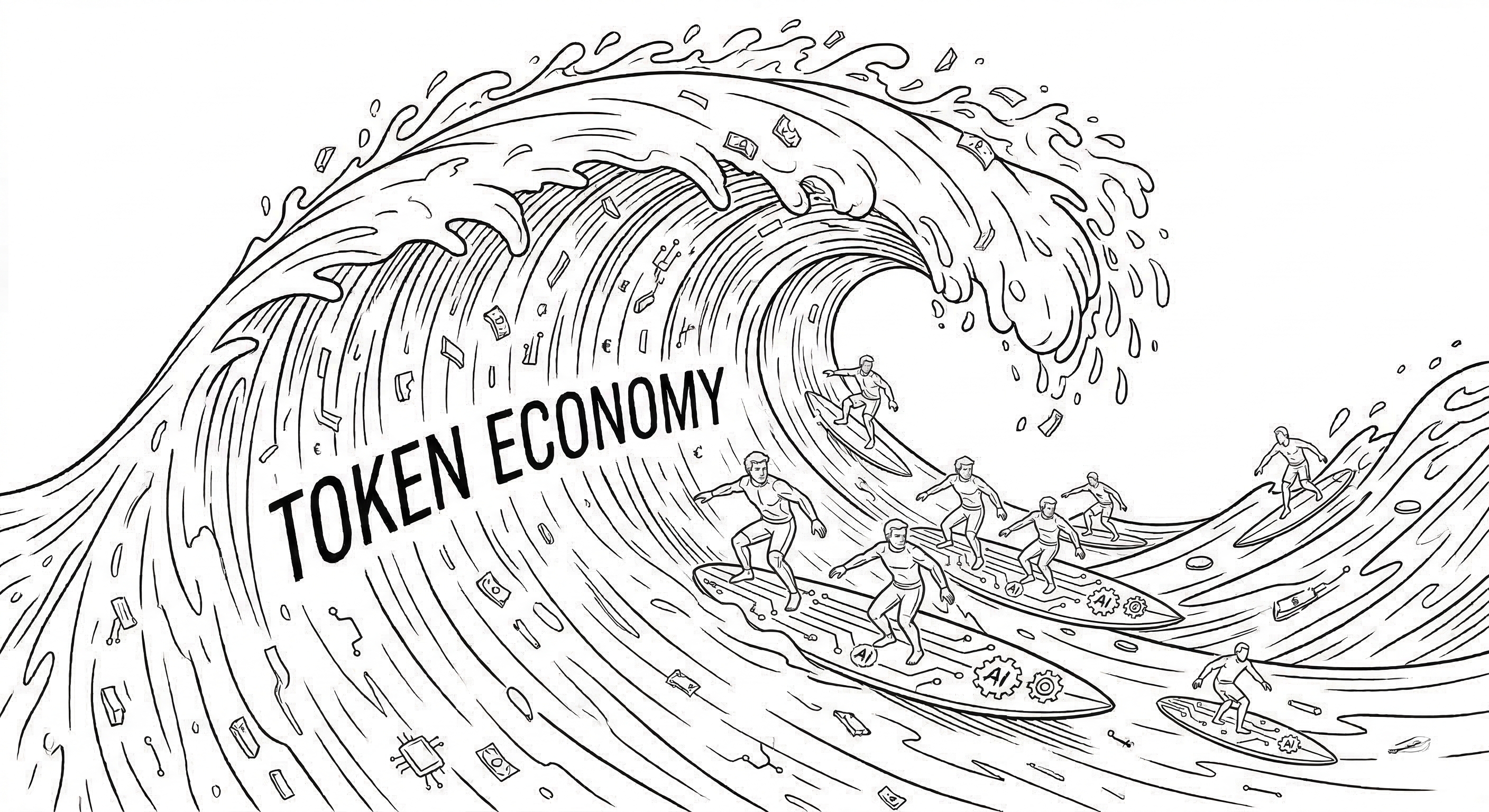
Ride the Wave or Get Crushed by It
The token economy is not arriving. It has arrived. It is already in the trade data, already in the enterprise P&L, already in Jensen Huang's projections for what his engineers will be paid next year.
We are genuinely at the beginning. The infrastructure is being built, the pricing tiers are forming, the compensation models are being invented in real time. What is already clear is that this wave does not wait. It does not pause for organizations to catch up, run pilots, finish the internal review process, or wait for the right budget cycle. The companies that treat the token economy as something to anticipate and shape, that build the instrumentation, the cost discipline, and the cultural shift toward tokens as productive capital now, will be the ones surfing the front of it. The others will feel it from behind, when the costs compound, when the competitors who moved earlier are operating at a speed and scale that is simply not catchable.
This is where we are. Not at a moment of decision about whether to engage with the token economy, but at a moment of decision about how deliberately to do it.